How to Choose the Right Variable Frequency Drive (VFD)?
At first glance, choosing a variable frequency converter seems quite simple: select the correct voltage, sufficient power rating, and a device at a suitable price. However, in my daily work I occasionally come across situations where a customer has chosen the wrong frequency converter. The reason is usually not a poor-quality device, but rather that some important selection criteria have been overlooked. Let’s take a closer look at what really matters when choosing a variable frequency drive.
The easiest way to choose a variable frequency drive
To be honest, the easiest and fastest way to find the right variable frequency drive is to ask someone who works with them every day. Contact us – we will help you choose a suitable solution and review which parameters are important for your specific application.
However, if you want to better understand why one variable frequency drive is suitable for a fan, another for a conveyor, and a third for a lifting application, it is worth looking at the topic in more detail.
Below, we will go through the main criteria for selecting a variable frequency drive and highlight some areas where an incorrect choice can cause problems later. Some mistakes become apparent immediately during commissioning, while others only appear after the equipment has been running for a few years and operating conditions change.
Application – what will the motor actually do?
One of the most important questions when selecting a variable frequency drive is: what will the motor actually be driving?
Although the operating principle of a variable frequency drive is always the same – controlling motor speed and operation – the requirements of different applications can be completely different. A motor running a fan requires a different approach compared to a motor that has to start a heavily loaded conveyor or move a lifting mechanism.
Let’s look at some common applications and what should be considered when selecting a variable frequency drive for them.
Conveyors
Conveyors are one of the most common applications for variable frequency drives. They usually use high-ratio gearboxes that provide the required torque and allow the movement of relatively large loads.
For conveyors, it can generally be assumed that the load torque is relatively constant – meaning that the motor must provide a similar amount of force at both lower and higher speeds.
For a standard indoor conveyor this is usually not a major issue, but outdoor applications can be more challenging. For example, in winter, starting problems can occur due to frozen gearbox lubricant, an iced conveyor belt, or simply higher starting resistance than usual.
In such cases, the motor must be able to provide sufficient torque immediately during start-up. The safest choice is to use a variable frequency drive with vector control, which allows better use of motor torque at low speeds.
If the conveyor needs frequent stops or rapid deceleration, it is also worth considering the use of a braking resistor. This helps dissipate regenerative energy generated during braking and prevents the variable frequency drive from going into an overvoltage condition.
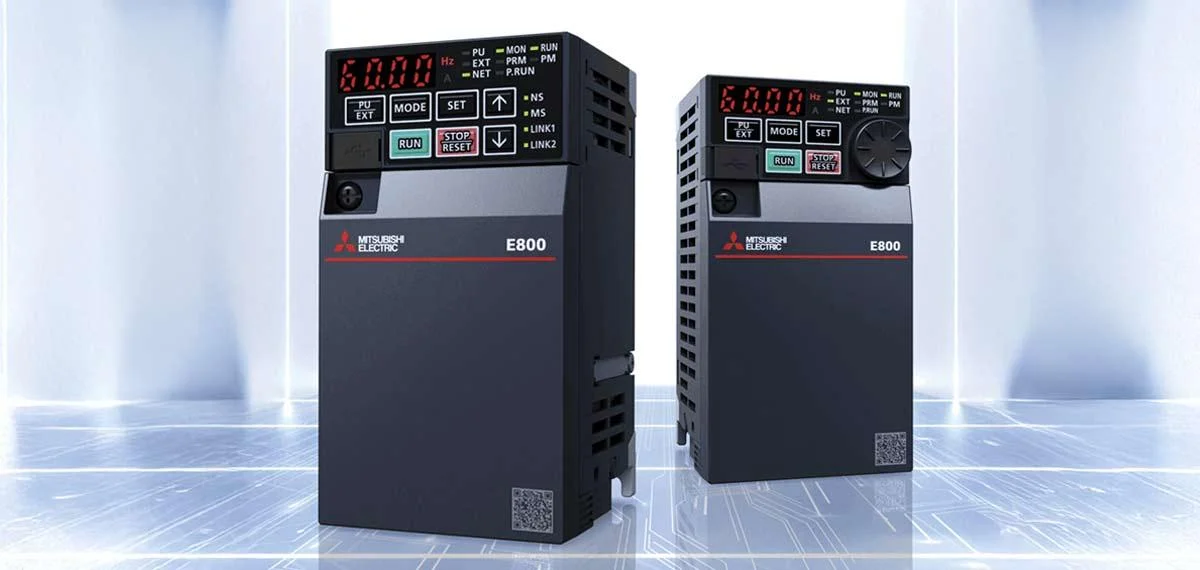
For conveyors, suitable solutions include Mitsubishi Electric FR-D800 and Mitsubishi Electric FR-E800 series variable frequency drives. For higher power applications (generally above 22 kW), it is worth considering the Mitsubishi Electric FR-A800 series.
Compressors
Compressors have many similarities with conveyors – sufficient starting torque and reliable control are also important here.
However, there is one important difference: compressors usually do not require rapid braking. Therefore, a braking resistor is generally not needed.
For compressors, smooth starting, stable pressure control, and energy savings are often more important. A variable frequency drive allows the compressor output to be adjusted according to actual demand instead of running the motor continuously at full speed.
Ventilation systems and pumps
When selecting a variable frequency drive for fans, slightly different principles apply compared to conveyors.
With conveyors, we want to achieve maximum performance even at low speeds, while fan load depends strongly on rotational speed. The starting torque required for a fan is small – even a very large fan can usually be turned quite easily by hand when stationary.
Fans and pumps benefit from smooth starting and gradual speed changes. The acceleration time can be tens of seconds or even minutes, which is a very suitable operating mode for a variable frequency drive.
One aspect that requires attention is the high inertia of large fans. Especially large axial fans may continue rotating for a long time after shutdown. If they are forced to stop too quickly, excessive regenerative energy may occur and the variable frequency drive can trip on overvoltage. The same applies to centrifugal pumps.
In some applications, airflow can cause a fan to rotate faster than the speed commanded by the variable frequency drive. In such cases, the function Regeneration avoidance operation selection can be useful. It increases motor speed when necessary and helps prevent excessive regenerative energy.
For fans and pumps, energy savings are often an important goal. Therefore, various energy-saving functions that adjust motor operation according to actual load conditions can be beneficial.
With smaller roof fans and borehole pumps, extra attention is needed. Although the motor power may be small, the motor winding insulation is not always designed to withstand the fast voltage peaks generated by a variable frequency drive.
The PWM output of a variable frequency drive creates rapid voltage changes (du/dt), which can place additional stress on motor insulation. Therefore, some fan manufacturers require the use of a du/dt filter or sine wave filter.
For ventilation applications, suitable solutions include Mitsubishi Electric FR-D800 and the specially designed Mitsubishi Electric FR-F800 series variable frequency drives for fans and pumps.
Screw conveyors
Screw conveyors are one of the applications where a variable frequency drive can really demonstrate its capabilities. Occasionally, a situation may occur where material becomes jammed inside the screw. There can be several reasons – excessive filling level, a foreign object, or simply uneven material flow – but the result is the same: the motor can no longer rotate and an overload condition occurs.
In such a situation, the fastest solution is often to briefly reverse the rotation, release the jammed material, and then continue operation in the correct direction. For this, the variable frequency drive must be able to provide sufficient torque at low speeds and withstand short-term overloads.
For controlling a screw conveyor, it is recommended to choose a powerful variable frequency drive with vector control, such as Mitsubishi Electric FR-D800 or the higher-capacity Mitsubishi Electric FR-E800.
Mixers and agitators
At first glance, mixers may seem like a fairly simple application – the motor simply rotates mixing blades. In reality, the operating conditions can vary significantly.
During normal operation, the material being mixed is often added gradually and the motor runs with a relatively stable load. However, problems can occur after a longer shutdown period. For example, heavier material may settle at the bottom of the tank and form a compacted layer. When restarting, the motor must overcome a much higher resistance than during normal operation.
Therefore, the selection of a variable frequency drive for mixers and agitators should not be underestimated. It is important that the drive can provide sufficient starting torque and operate reliably under overload conditions.
For such applications, variable frequency drives with powerful vector control are suitable, for example Mitsubishi Electric FR-D800, Mitsubishi Electric FR-E800 and, for higher power applications, Mitsubishi Electric FR-A800.
Lifting equipment
Lifting applications always require a separate approach when selecting a variable frequency drive. In addition to strong vector control, the drive must also be able to properly handle the regenerative energy generated when lowering a load.
When a load is lowered, the motor starts operating as a generator and energy flows back into the DC bus of the variable frequency drive. If this energy cannot be dissipated, the voltage rises too high and the drive stops operation.
Suitable solutions for lifting applications include Mitsubishi Electric FR-D800, Mitsubishi Electric FR-E800 and, for higher power applications, Mitsubishi Electric FR-A800. These drives offer excellent vector control performance and include a built-in braking transistor with control circuitry. To use this function, a suitable braking resistor must always be added to convert regenerative energy into heat.
In some lifting applications, lowering a load may take a long time or occur very frequently. In such cases, the capacity of the drive’s built-in braking transistor may not be sufficient, and a separate higher-power braking unit together with a suitable braking resistor may be required.
Dynamic drives
It is worth separately highlighting applications where the drive must accelerate and decelerate very frequently, with operating cycles lasting only a few seconds. Such solutions are commonly found in high-speed production machines, positioning systems, and various automation applications.
In these applications, motor power alone is not enough – the speed and accuracy of the variable frequency drive control are critical. The motor condition must be measured and controlled very quickly to provide the required torque during both acceleration and braking.
For such applications, it is important to choose a variable frequency drive with advanced vector control. In the Mitsubishi Electric range, one of the best solutions is the Mitsubishi Electric FR-E800, whose high-performance processor and fast motor circuit measurement enable highly dynamic control.
Motor rated voltage – 1 phase or 3 phase?
Let’s make one thing clear right away: controlling a single-phase motor with a variable frequency drive usually does not provide good results. Although special solutions exist for this purpose, their use is limited and it is often not possible to achieve the same level of control as with a three-phase motor.
At this point, it is important to distinguish between two things: single-phase power supply and single-phase motor. A variable frequency drive supplied from a single-phase network (1×230 V) is a completely standard solution. Such a drive provides a three-phase output voltage, typically 3×230 V, and is used together with a 230/400 V motor connected in delta (Δ). These types of drives are commonly available up to approximately 2.2 kW motor power.
Therefore, in the following sections, we will assume that the motor is three-phase.
The most common voltages for three-phase motors are 230 V, 400 V and, for larger motors, also 690 V. Many motors specify both winding connection options, allowing the motor to be connected either in delta (Δ) or star (Y).
For example, a motor marking 230/400 V means that the motor must be connected in delta when supplied with 230 V and in star when supplied with 400 V. Similarly, 400/690 V means that the motor operates in delta on a 400 V network and in star on a 690 V network.
It is important to remember that a variable frequency drive does not increase the input voltage. If the motor requires 400 V, a variable frequency drive with a 400 V output must also be used. A drive with a 230 V output cannot provide the required voltage to the motor, and the motor will not achieve its full rated power.
Should the drive be selected by power or rated current?
This is probably one of the most common questions when selecting a variable frequency drive. Should the selection be based on the motor’s kilowatt rating or its rated current?
The answer is simple: a variable frequency drive should primarily be selected according to the motor’s rated current.
Let’s look at three 5.5 kW motors:
| Motor | Rated power | Rated current |
|---|---|---|
| 3EC112M2D, 3000 rpm | 5.5 kW | 10.4 A |
| 3ZG132M6D, 1000 rpm | 5.5 kW | 11.6 A |
| TWI 6.18-10-C borehole pump | 5.5 kW | 13.7 A |
As you can see, all motors have the same rated power – 5.5 kW – but their rated currents differ significantly.
The reason is simple: a variable frequency drive controls the motor based on current. The current determines how much load the drive must be able to deliver to the motor. Therefore, when selecting a variable frequency drive, always check the rated current on the motor nameplate first, and only then consider the power rating.
Power is a good guideline, but the final selection is determined by the rated current.
Normal Duty or Heavy Duty?
Knowing the motor rated current is not the final step. The next question is to determine which load class the variable frequency drive can handle for that current.
Most manufacturers offer two load classes – Normal Duty (ND) and Heavy Duty (HD). Mitsubishi Electric has gone further by expanding the range to four different load classes.
| Load class | Typical application | Allowed overload |
|---|---|---|
| SLD – Super Light Duty | Fans, pumps | 110% / 60 s, 120% / 3 s |
| LD – Light Duty | Winding machines, centrifuges | 120% / 60 s, 150% / 3 s |
| ND – Normal Duty | Conveyors, general industrial drives | 150% / 60 s, 200% / 3 s |
| HD – Heavy Duty | Screw conveyors, mixers, crushers, lifting equipment | 200% / 60 s, 250% / 3 s |
The more demanding the application, the higher overload capacity the variable frequency drive must provide for short periods. For example, a fan usually does not require high starting torque, while starting a screw conveyor or lifting equipment may require the motor to draw several times its rated current for a short time.
Therefore, a variable frequency drive should not be selected only based on motor power. Always consider both the motor rated current and the application load class. This ensures that the drive does not operate constantly at its limits and can provide reliable service for many years.
Is it worth selecting a variable frequency drive one size larger?
A common question is whether the variable frequency drive should be selected with extra margin – for example, choosing a 7.5 kW drive for a 5.5 kW motor. At first glance, a larger drive may seem like a safer choice, but it is not always the best solution.
It is not possible to generalize for all manufacturers, but Mitsubishi Electric variable frequency drives are designed to operate very accurately according to the motor’s rated parameters. If the drive is selected according to the motor rated current and the application matches the manufacturer’s load class, there is usually no reason to select a larger model.
One reason is the accuracy of the drive’s internal measurement circuit. The variable frequency drive must measure motor current very accurately because motor control and protection are based on this measurement. Simplified, a sensor with a very large measuring range may not provide the same accuracy when measuring small currents as a sensor designed for a smaller range. For example, a 100 A measurement circuit is not intended to measure currents around 5 A with maximum accuracy.
Therefore, selecting a drive that is too large can in some cases reduce control accuracy, especially when using advanced control methods such as vector control.
Selecting a larger variable frequency drive may be justified when:
- the motor temporarily operates under higher load;
- high current peaks occur during starting;
- the load changes significantly or is difficult to estimate;
- higher overload capability is required.
However, it should be considered that too large a difference between the motor size and the drive size can create problems during automatic motor tuning. If the variable frequency drive is several sizes larger than the motor, identifying motor parameters and optimizing vector control may become more difficult.
In practice, it is best to follow this principle: select the variable frequency drive according to the actual motor rated current and application requirements, not simply by choosing a larger model with extra margin. A correctly selected drive provides better control, more accurate protection and often a lower investment cost.
Conclusion
In this article, we covered some of the most important parameters that should be considered when selecting a variable frequency drive – motor voltage, supply type, rated current, load class and correct drive sizing.
There are certainly many other topics that were not covered. These include the differences between controlling standard induction motors, permanent magnet motors (PM) and synchronous reluctance motors (SynRM), motor control with encoder feedback, and many application-specific details.
Every application is different, and simply looking at motor power and nameplate data is not always enough. The correct choice of a variable frequency drive depends on the motor, load, operating conditions and the required control accuracy.
If you are unsure which variable frequency drive is the right choice for your application, feel free to contact us. We do not simply sell variable frequency drives – we know the technology and help you choose a solution that will actually work.


