Vector Control in Variable Frequency Drives – Explained Simply
When selecting a variable frequency drive for more demanding applications, vector control quickly becomes part of the conversation. Sometimes it may feel like just another fancy term used in sales talk to sound impressive. But is that really the case?
In reality, vector control has a very clear and practical purpose – especially when the motor is expected to deliver torque, smooth operation and good controllability even at low speeds.
Let’s start from the beginning and explain it in plain language.
How is a motor usually controlled?
With an induction motor, the basic logic is simple:
- frequency determines rotational speed
- voltage determines how strong the magnetic field inside the motor is
The simplest control method is so-called V/f control, where the frequency drive keeps voltage and frequency in a linear relationship. When frequency decreases, voltage decreases as well. This approach works and is perfectly sufficient for many simple applications.
Problems arise when:
- the motor has to operate at low speed
- the load changes
- good torque is required already during start-up
This is where V/f control starts to struggle.
Why is V/f alone not enough?
V/f control does not really know what the motor is doing at any given moment.
It does not ask:
- how large the load is
- how much torque is actually required
- whether the motor is cold or warm
It simply maintains voltage and frequency. The result can be:
- weak torque at low speeds
- slow response to load changes
- higher losses and a hotter motor
This is where vector control comes into play.
What is vector control – in simple terms?
The idea behind vector control is simple:
to control torque and magnetic flux separately.
The frequency drive measures the motor currents and mathematically splits them into two components:
- one component creates the magnetic field
- the other component produces torque
By controlling these two components independently, the motor can be controlled much more precisely. In essence, the induction motor is made to behave like a DC motor, where “field” and “torque” are separated and easily controlled.
Although this sounds complex, modern frequency drives handle all of this internally. For the user, it simply means a motor that behaves better.
What is magnetic flux?
Magnetic flux is the magnetic field created inside the motor that “locks onto” the rotor and allows it to rotate together with the stator field. Without magnetic flux, the motor may draw current but cannot produce torque.
Creating magnetic flux always consumes a portion of electrical energy, regardless of whether the motor is loaded or not. Too little flux makes the motor weak and unstable; too much flux only generates excess heat without increasing useful torque.
One of the major advantages of vector control is that the drive keeps magnetic flux at an optimal level at all times and controls torque separately – allowing the motor to do exactly as much work as needed, without wasting energy.
Autotune – a small step with a big impact
For vector control to work properly, the drive needs to know the characteristics of the motor it is controlling. This is achieved using autotune.
During autotune, the drive measures, among other things:
- stator resistance
- inductances
- magnetization characteristics
Depending on the drive model and the depth of measurement, autotune may:
- take only a few seconds
- or take several tens of seconds or even longer for more detailed tuning
It is important to remember that autotune should be performed with a cold motor, as motor parameters change with temperature.
Mitsubishi Electric vector control in practice
Mitsubishi Electric frequency drives allow powerful motor control from approximately 1 Hz, even without speed feedback.
This means that:
- the motor does not stall at low speeds
- torque remains stable
- speed holds better under changing load
Of course, a solution with an encoder provides even higher precision and dynamic performance and is justified in applications where accuracy is critical. However, in many industrial applications, sensorless vector control performs very well.
Low speeds and cooling – an important reminder
One thing that must not be forgotten when using vector control is motor cooling.
The fan mounted on the motor shaft:
- cools the motor effectively near rated speed
- becomes practically ineffective at low speeds
If the motor operates:
- at low frequencies
- with high load
- for extended periods
additional cooling, a larger motor, or duty cycle limitations should be considered. Vector control helps maintain torque, but it cannot override the laws of physics.
Applications where vector control is essentially unavoidable
Vector control is especially important in all applications that require powerful yet smooth operation at low speeds.
For example:
- hoists and cranes
- mixers and agitators
- crushers
- screw conveyors
- heavily loaded starting mechanisms
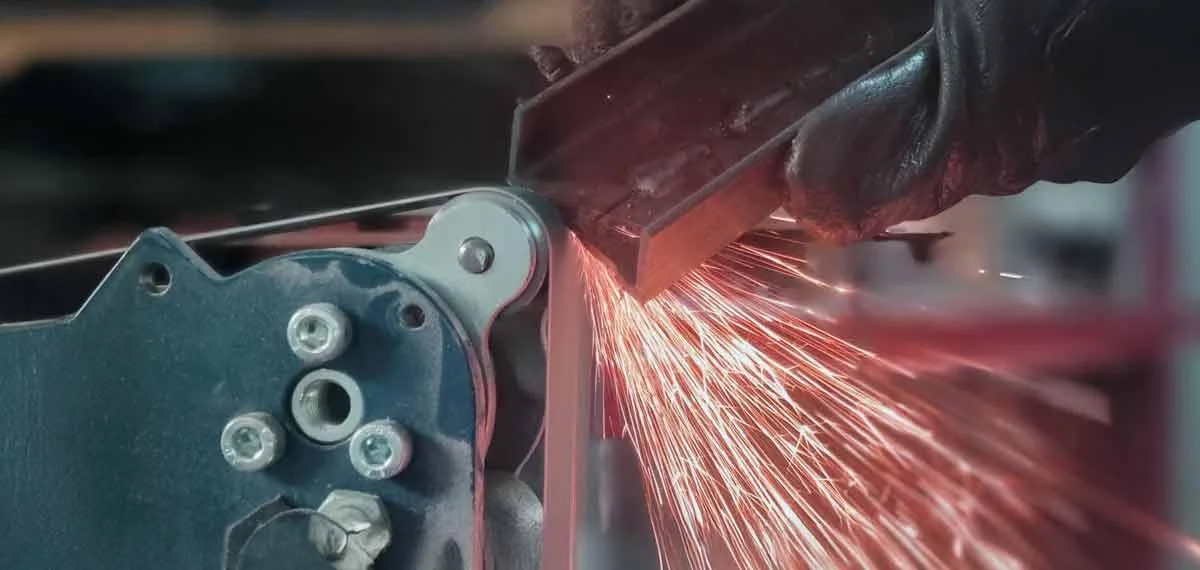
A good practical example is a belt grinder in a workshop. When grinding hardened steel with fine grit belts, it is critical to avoid overheating the material. One effective way is to significantly reduce speed while still maintaining torque. Vector control allows exactly that.
Does vector control help save energy?
Yes – intelligently.
Vector control does not increase the motor’s nominal efficiency, but it:
- keeps magnetic flux at an optimal level
- avoids unnecessary current draw
- reduces losses at partial load and low speeds
- responds faster to load changes
The result is a cooler motor and lower energy consumption exactly where most drives actually operate – not continuously at rated speed.
In conclusion
Vector control is not just a “better mode” in a frequency drive.
It is a tool that:
- improves motor controllability
- delivers torque where it is needed
- makes drive operation smoother and more stable
- helps save energy in many applications
If a motor needs to perform real work – especially at low speeds – vector control is very often the only sensible choice.


